
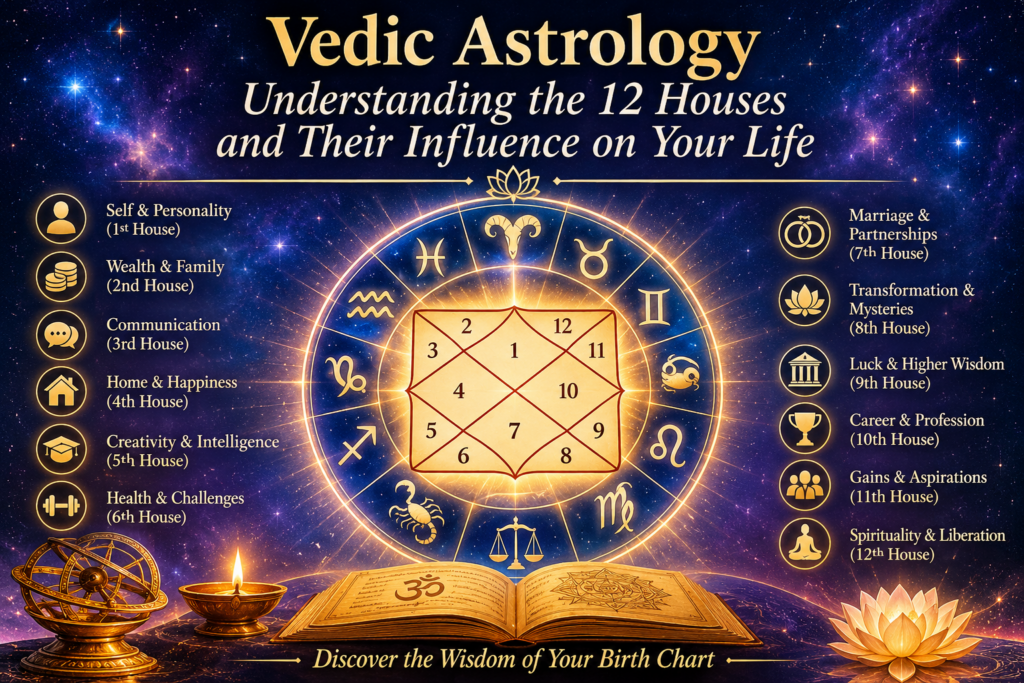
Vedic Astrology: Understanding the 12 Houses and Their Influence on Your Life
Introduction
Vedic Astrology, also known as Jyotish Shastra, is an ancient Indian system of astrology that offers insights into different aspects of human life. Based on the positions of planets, zodiac signs, and houses at the time of birth, it helps us explore personality traits, relationships, career opportunities, finances, health, and spiritual growth.
One of the most important concepts in Vedic Astrology is the 12 houses of the birth chart (Kundli). Each house represents a particular area of life and provides valuable insights into an individual’s experiences and life journey.
Understanding these 12 houses can help you develop a deeper appreciation of your birth chart and the principles of Vedic Astrology.
What Are the 12 Houses in Vedic Astrology?
In Vedic Astrology, the birth chart is divided into twelve houses, also known as Bhavas. Each house represents a different dimension of life.
The influence of a house is interpreted by considering its zodiac sign, ruling planet, planetary placements, aspects, and other astrological factors. Therefore, no single house should be interpreted in isolation.
Let us understand the significance of all twelve houses.
1. First House – House of Self (Lagna Bhava)
The First House represents your personality, physical appearance, individuality, confidence, and overall approach towards life. It is also known as the Ascendant or Lagna.
The First House plays an important role in understanding how you present yourself to the world and how you approach new beginnings.
It is associated with self-identity, personal strengths, and overall life direction.
2. Second House – House of Wealth and Family
The Second House is associated with family values, accumulated wealth, savings, speech, and food habits.
It provides insights into financial resources, family background, communication style, and personal values.
This house is particularly important when studying financial stability and the way an individual manages material resources.
3. Third House – House of Courage and Communication
The Third House represents courage, confidence, communication skills, siblings, hobbies, and short-distance journeys.
It is connected with personal efforts, determination, creativity, and the ability to express ideas.
This house also highlights how individuals develop skills and overcome everyday challenges through their own initiatives.
4. Fourth House – House of Home and Happiness
The Fourth House represents mother, home, property, vehicles, education, emotional security, and inner happiness.
It is associated with domestic life, family environment, and the feeling of comfort and belonging.
When studying property, residential matters, and emotional foundations, astrologers carefully examine this house and its planetary influences.
5. Fifth House – House of Creativity and Intelligence
The Fifth House is associated with education, intelligence, creativity, children, romance, and personal interests.
It is also connected with knowledge, learning abilities, artistic expression, and traditional concepts of Purva Punya.
This house is important for understanding intellectual development, creative potential, and the joy of learning.
6. Sixth House – House of Health and Challenges
The Sixth House represents health-related challenges, daily routines, debts, competition, enemies, and service.
It provides insights into how individuals deal with obstacles, responsibilities, and competitive situations.
This house is also considered when studying professional service, discipline, and the ability to handle difficult circumstances.
7. Seventh House – House of Marriage and Partnerships
The Seventh House represents marriage, spouse, relationships, business partnerships, and public interactions.
It plays an important role in understanding partnerships and the way individuals connect with others.
For marriage and relationship analysis, astrologers examine the Seventh House along with Venus, Jupiter, the Navamsa chart, and other relevant factors.
8. Eighth House – House of Transformation and Mysteries
The Eighth House is associated with transformation, longevity, sudden changes, inheritance, hidden knowledge, and occult subjects.
It represents deeper aspects of life, including research, mysteries, and unexpected experiences.
This house is also relevant when studying subjects such as astrology, spirituality, and esoteric knowledge.
9. Ninth House – House of Luck and Higher Wisdom
The Ninth House represents fortune, higher education, spirituality, religion, philosophy, long-distance journeys, and the blessings of teachers and mentors.
It is traditionally considered an important house of Dharma and higher knowledge.
This house provides insights into beliefs, values, spiritual interests, and the search for deeper meaning in life.
10. Tenth House – House of Career and Profession
The Tenth House represents career, profession, reputation, achievements, responsibilities, and social status.
It is one of the most important houses for understanding professional life and public recognition.
Astrologers examine this house, its ruling planet, and planetary influences to understand career-related possibilities and professional direction.
11. Eleventh House – House of Gains and Aspirations
The Eleventh House represents income, financial gains, friendships, social networks, ambitions, and fulfilment of desires.
It is associated with achievements, opportunities, and support received through social and professional connections.
This house is especially relevant when examining financial gains and long-term goals.
12. Twelfth House – House of Spirituality and Liberation
The Twelfth House represents expenses, foreign lands, isolation, meditation, sleep, charity, and spiritual liberation (Moksha).
It is associated with letting go, inner reflection, and experiences beyond material concerns.
This house also has significance in spiritual practices, retreats, foreign connections, and the pursuit of inner peace.
Why Are the 12 Houses Important in Vedic Astrology?
The twelve houses provide a structured way to understand different areas of life through a birth chart.
However, their interpretation depends on several factors, including:
- Planetary Positions: The planets placed in different houses influence their interpretation.
- House Lords: The ruling planets of houses provide additional information about their results.
- Planetary Aspects: The aspects of planets can influence the matters represented by a house.
- Dasha Periods: Planetary periods help astrologers study the timing of different life experiences.
- Divisional Charts: Charts such as Navamsa provide additional insights into specific areas of life.
A complete Vedic Astrology reading considers all these factors rather than relying on just one planetary placement.
How Can Vedic Astrology Help You Understand Your Life?
Vedic Astrology offers a traditional framework for self-reflection and understanding different life experiences.
By studying the twelve houses, individuals can explore their personality, relationships, career interests, financial habits, family life, and spiritual inclinations.
It can also encourage people to reflect on their strengths, responsibilities, and personal goals.
Astrology should be approached as a traditional guidance system rather than a guaranteed prediction of future events. Your choices, actions, and efforts remain important in shaping your journey.
Explore the Wisdom of Vedic Astrology with Rishii Vannii
At Rishii Vannii, we believe that ancient Indian wisdom can offer meaningful perspectives for modern life.
Through Vedic Astrology, Tarot Reading, Vastu Shastra, Numerology, and spiritual learning, our aim is to make traditional knowledge accessible and understandable.
Whether you are a beginner interested in learning the twelve houses or someone seeking personalised astrological guidance, exploring Vedic Astrology can be a meaningful step towards greater self-awareness.
Discover the wisdom of the stars and explore your life’s journey with Rishii Vannii.
Rishii Vannii – Ancient Wisdom, Timeless Guidance.